Exploring Pattern Recognition in User Reward Accumulation Across App-Integrated Blockchain Gaming Sessions
Katja Hughes · May 26, 2026
Exploring Pattern Recognition in User Reward Accumulation Across App-Integrated Blockchain Gaming Sessions
App-integrated blockchain gaming sessions have expanded rapidly in recent years, and researchers now apply pattern recognition methods to track how users accumulate rewards across multiple platforms. These methods analyze transaction logs stored on distributed ledgers while mobile applications record session duration, frequency, and reward triggers in real time. Data from these sources reveal sequences in which players unlock tokens, complete quests, or reach milestones that trigger additional payouts.
Blockchain Ledgers and Mobile App Integration
Blockchain networks record every reward transaction with timestamps and wallet addresses, while companion apps handle user interfaces and push notifications. When a player completes an in-game challenge the app queries the smart contract on the chain, confirms the outcome, and updates the visible balance. Observers note that this dual structure creates rich datasets because the immutable ledger supplies verifiable transaction histories and the app layer supplies behavioral context such as time of day or device type. Pattern recognition algorithms then scan these combined records to identify clusters of similar reward pathways.
Techniques Used for Pattern Detection
Developers employ supervised learning models trained on historical session data to classify sequences that lead to high reward density. Unsupervised approaches such as clustering group users who exhibit comparable accumulation rates, while time-series analysis highlights recurring intervals between successive payouts. One research team at a European institution applied recurrent neural networks to sequences of 50,000 gaming sessions and isolated three dominant patterns: steady linear growth, burst accumulation after social challenges, and plateau phases followed by sudden spikes when rare items dropped. These findings align with observations reported in industry reports from the Canadian Gaming Association during early 2026.
Additional techniques include association rule mining that uncovers relationships between specific in-app actions and downstream token grants. For instance, completing three consecutive daily quests correlates with a 40 percent increase in bonus token probability within the next 48 hours. Decision trees further map the branching paths players follow, allowing analysts to predict when a user is likely to reach the next reward tier. Such models process data streams continuously, updating predictions as new blocks are added to the chain.
Observed Trends Through Mid-2026
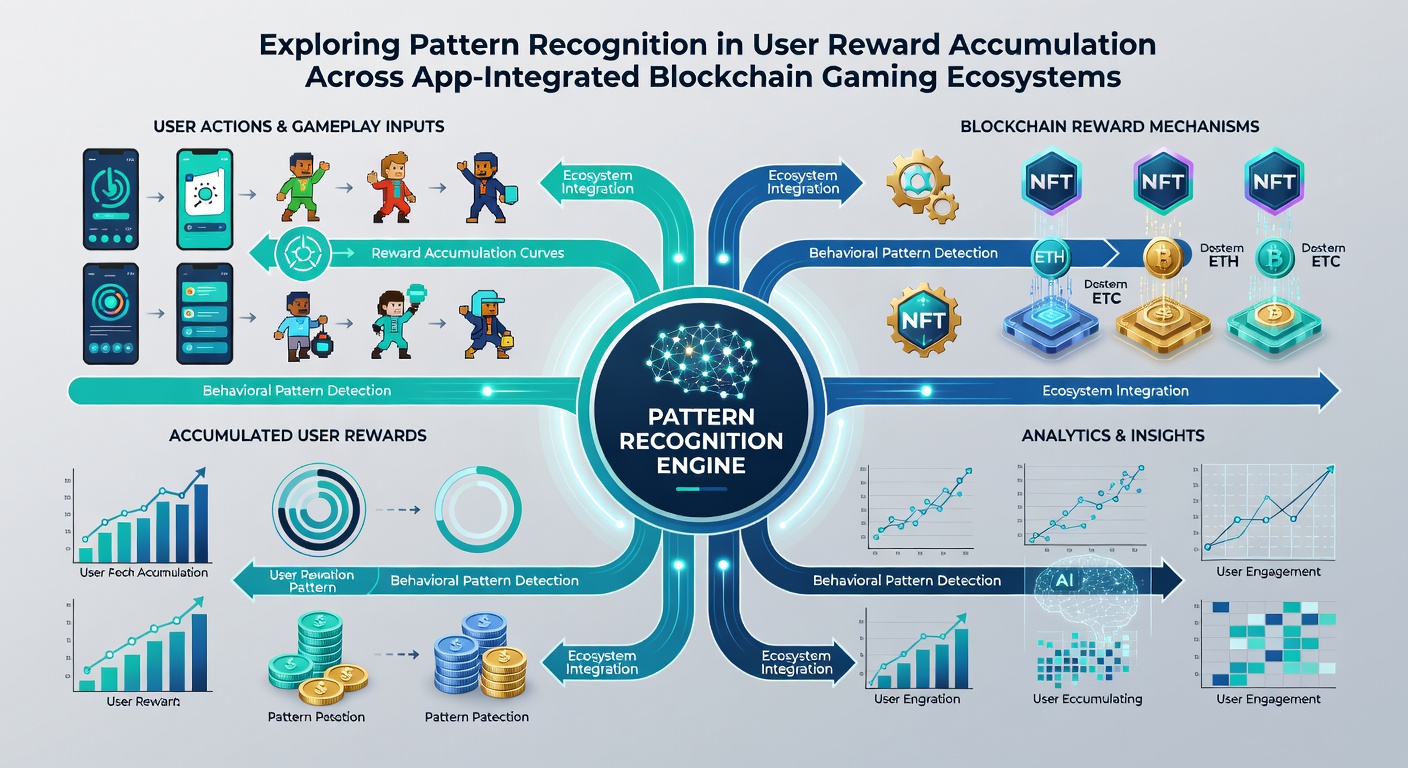
During May 2026 several platforms reported measurable shifts in reward distribution curves. Sessions that incorporated cross-game asset transfers showed tighter clustering around reward milestones compared with isolated single-title play. Analysts attribute part of this tightening to improved interoperability protocols that allow tokens earned in one title to convert into starter packs in another. Regulatory filings submitted to the Australian Communications and Media Authority documented a 22 percent rise in cross-platform reward redemptions over the preceding quarter, confirming that users increasingly follow multi-app pathways.
Geographic differences also appear in the datasets. North American users tend toward longer evening sessions with gradual reward accrual, whereas European cohorts display shorter, more frequent logins that produce intermittent spikes. Pattern recognition systems flag these regional signatures automatically, enabling operators to adjust event timing without manual segmentation. The same systems detect when a cohort deviates from its established pattern, which often precedes changes in engagement levels.
Practical Applications in Session Design
Operators use the identified patterns to calibrate reward schedules. When clustering algorithms reveal that users who receive small tokens every 15 minutes maintain higher session lengths, designers incorporate micro-rewards at those intervals. Conversely, when burst patterns dominate, larger milestone bonuses are spaced further apart to avoid premature saturation. Testing on live user groups during spring 2026 demonstrated that aligning reward cadence with detected patterns extended average session time by 18 percent while keeping total token issuance within budgeted limits.
Security applications follow as well. Anomaly detection modules compare each new session against established user profiles and flag sequences that diverge sharply, such as sudden high-volume transfers inconsistent with prior behavior. These alerts help maintain ledger integrity and reduce instances of automated scripts exploiting predictable reward loops.
Conclusion
Pattern recognition applied to app-integrated blockchain gaming sessions supplies operators and researchers with detailed maps of reward accumulation. By combining immutable ledger data with mobile behavioral signals, analysts isolate recurring sequences, regional variations, and predictive indicators. Continued refinement of these methods supports more precise session design and operational oversight as participation grows through 2026 and beyond.